The fraud and integrity checks at the heart of 9thSense — what they catch, and how they gate every verification
Checks Overview
Extraction tells you what a document says. Checks tell you whether you should believe it.
Every 9thSense verification — document, image, video, or live session — runs through a layered set of checks before a case can complete. Each check returns a structured verdict with a confidence score, contributes evidence to the case audit trail, and can block, flag, or route the case according to your Goal Rules.
Why checks come first
Document fraud has changed. The threats we see in production today are not photocopied forgeries — they are:
- Deepfaked video in video-KYC sessions, where the "customer" on camera is a face-swap or a replayed recording.
- AI-generated documents — bank statements, salary slips, and utility bills synthesized from scratch, pixel-perfect, with internally consistent numbers.
- Presentation attacks — a printed photo, a screen replay, or a mask presented to a selfie camera.
- Frankenstein identities — genuine documents from different people stitched into one application.
A platform that only extracts fields is blind to all four. 9thSense treats fraud detection as a first-class layer, not an add-on.
The check families
Deepfake Detection
Detects face swaps, reenactment, and generated video in selfies and live sessions. See Deepfake Detection.
Liveness
Confirms a real, present human — not a photo, screen replay, or mask. Passive and active modes, plus temporal checks across a full video session. See Liveness.
Face Match & Likeness
1:1 likeness between the live face and the ID photo, and 1:N search across configured biometric databases. A face anchor tracks that the same person stays on camera for the whole session. See Face Match & Likeness.
Lip-Sync & AV Integrity
Verifies that the voice on the call is produced by the face on camera — catching dubbed audio, voice cloning over real video, and injection attacks. See Lip-Sync & AV Integrity.
Synthetic & Tampered Documents
Flags AI-generated and edited documents: font and layout anomalies, metadata inconsistencies, arithmetic that doesn't add up, and template mismatches. See Synthetic & Tampered Documents.
Cross-Verification
Compares names, dates of birth, addresses, and photos across every document in a case, and resolves entities across cases to catch repeat and composite identities. See Cross-Verification.
Deterministic + AI, together
Checks come in two kinds, and the strongest verifications use both:
| Kind | Examples | Character |
|---|---|---|
| Deterministic | ID-number checksums, date validity, format rules, cross-field arithmetic | Always the same answer for the same input. Zero hallucination risk. Cheap. |
| Model-based | Deepfake detection, liveness, face likeness, synthetic-document signals | Probabilistic, returns a confidence score you threshold via Goal Rules. |
Deterministic checks are expressed as Goal Rules — the declarative checklist an agent must satisfy before a case can complete. Model-based checks feed their verdicts into the same rules, so a single policy governs everything: "liveness confidence ≥ 0.9, face match ≥ 0.85, ID checksum valid, names consistent across all documents — otherwise route to review."
Every check is evidence
Each check produces an immutable execution record: verdict, confidence, the inputs it saw, and (for video checks) timestamped markers you can jump to in the session recording. Six months later, an auditor can see exactly which checks ran, what they found, and why the case was approved or denied.
When a check flags, the case routes to a human with the evidence laid out — here an income-assessment case held for review because the identity cross-match warned that the PAN on the ITR differs from the declared one:
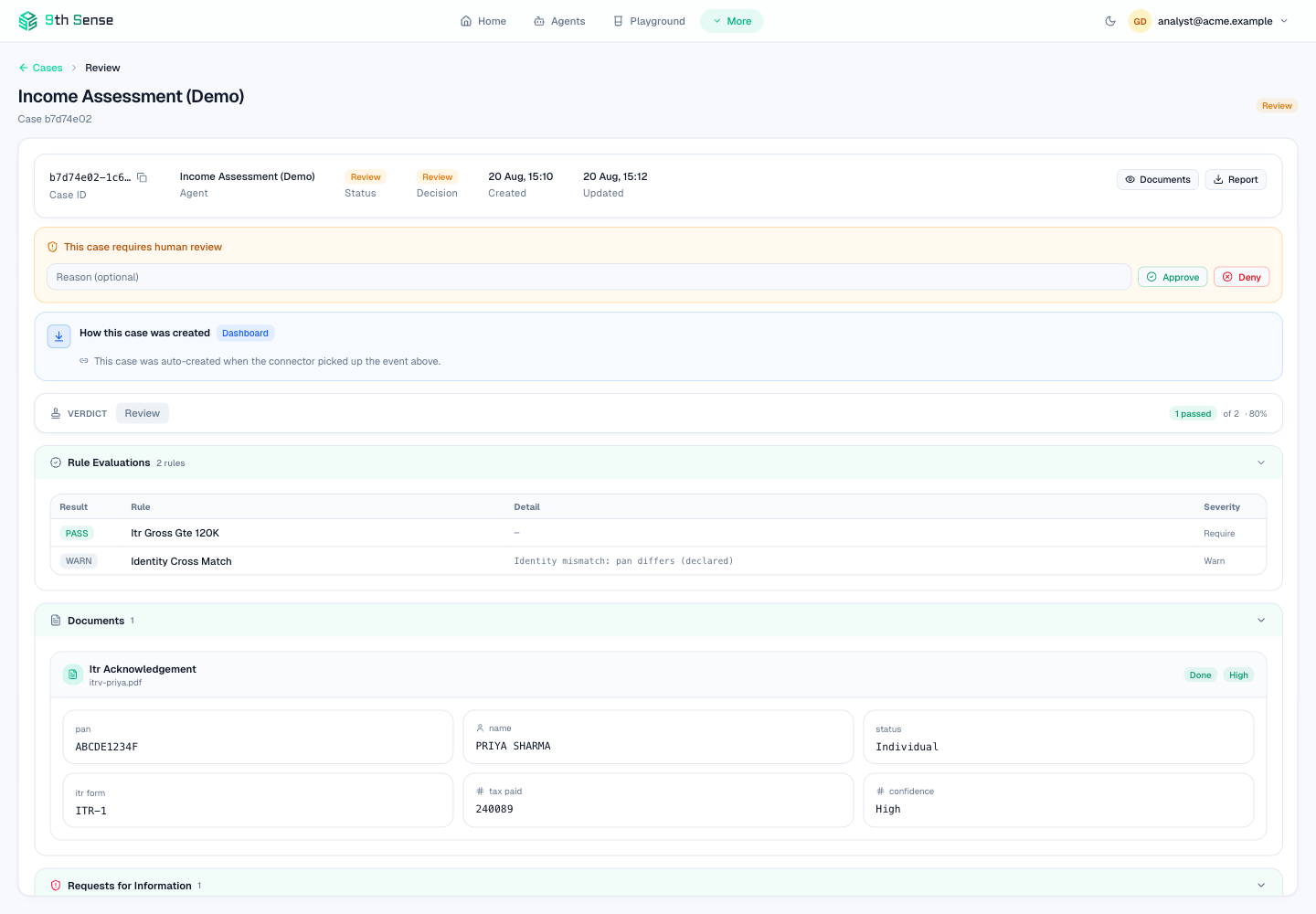 Case review page — Income Assessment case in Review status with a human-review banner and Approve/Deny actions; rule evaluations show the income threshold passing and an identity cross-match warning that the PAN differs from the declared identity; extracted ITR fields below
Next steps
Goal Rules
Learn the declarative policy language that turns check results into decisions. See Goal Rules.
Build a KYC Agent
Wire checks and goal rules into an end-to-end verification flow. See Build a KYC Agent.